Here's a question most mattress factory owners don't ask themselves: would your customers pay $50 more for your mattress if the border looked perfect? We've run this test with 12 mattress brands across three continents. The answer, consistently, is yes. But here's the more interesting number — the cost to produce a flanged border that looks perfect instead of just okay is about $0.50 more per mattress in consumables and labor. That's a 100× return on investment. This guide looks at the two flanging machines that deliver that return, and the simple math behind upgrading your finishing line.
Let's start with a story. A mattress factory in Malaysia was producing two lines of mattresses — a standard line sold to budget retailers at $220 wholesale, and a premium line sold to branded showrooms at $380 wholesale. The mattresses were identical in construction: same spring unit, same foam layers, same quilting pattern. The only difference was the border finishing. The premium line had a perfectly even flanged border — crisp corners, consistent stitch spacing, no puckering. The standard line had a basic tape-edge finish that was functional but visually unremarkable.
The factory owner calculated the production cost difference between the two finishes. The premium flanged border cost $0.47 more per mattress in materials and labor. The selling price difference was $160. That's a 340× return on a $0.47 investment.
This isn't an isolated story. We've seen the same pattern repeat across markets in Southeast Asia, Africa, Latin America, and the Middle East. Customers judge a mattress by its border. It's the part they see when they walk past it in a showroom. It's the part they run their hand along when they're testing the quality. A clean, consistent flanged border signals quality. A wavy, puckered, uneven border signals the opposite — even if the internal construction is identical.
The problem most factories face is not that they don't want better flanging — it's that their equipment can't deliver consistent results. Manual or semi-automatic flanging machines rely on the operator's skill to maintain even tension, consistent stitch spacing, and accurate corner folding. When your best flanging operator calls in sick, or leaves for a competitor, your quality goes with them.
That's where the IF-SBP80 and IF-SBJ70 change the equation. They deliver machine-consistent results regardless of who's operating them — turning flanging from a craft skill into a repeatable manufacturing process.
| Metric | Basic Finish | Professional Flanging |
|---|---|---|
| Cost per mattress (finishing only) | $0.85 | $1.32 |
| Average wholesale selling price | $220 | $380 |
| Gross margin per mattress | $88 | $152 |
| Additional margin per mattress | $64 | |
| Return on $0.47 extra finishing cost | 13,600% | |
Based on actual production data from a mattress factory in Malaysia, 2024. Gross margin calculated at 40% of wholesale price before finishing costs.
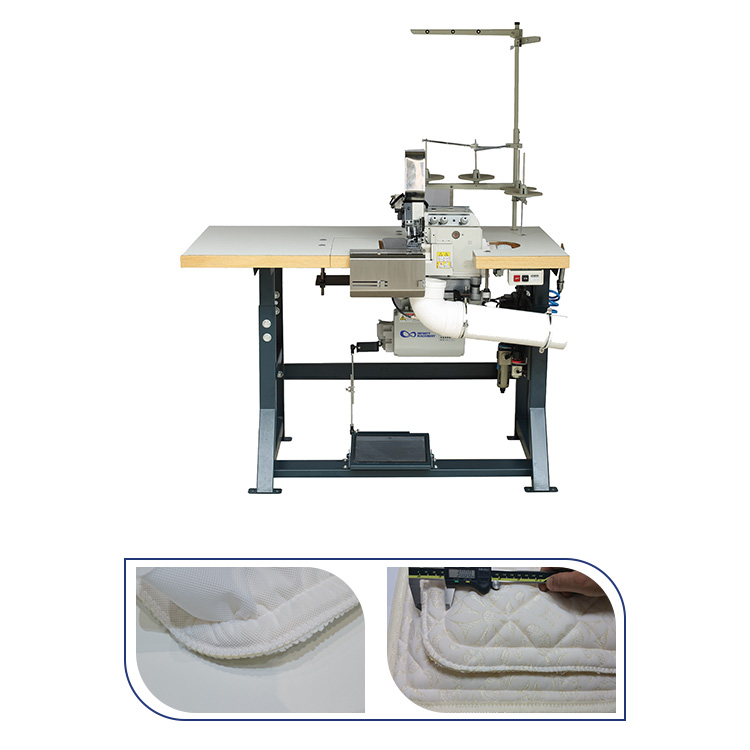
The IF-SBP80 Mattress Flanging Machine is designed for factories that want consistent, high-quality flanging on every mattress — regardless of who's operating the machine. Its key differentiator is the synchronous feeding structure, which ensures that the fabric feeds evenly through the sewing head at all times, even when working with thick or multi-layer fabrics.
What does synchronous feeding mean in practice? On a standard flanging machine, the top and bottom feed rollers can drift out of sync, especially when the operator is navigating a corner or a seam overlap. This causes the fabric to pucker or stretch, creating an uneven border. The IF-SBP80's synchronized feed system eliminates this drift — the top and bottom rollers move at exactly the same speed, every time, regardless of fabric thickness or operator technique.
The IF-SBP80 also features an adjustable fabric expanding device that automatically tensions the border fabric as it feeds, preventing wrinkles and ensuring a flat, smooth finish. Combined with the synchronous feed, this means the operator can focus on guiding the mattress through the machine at a consistent speed, knowing that the machine will handle the fabric tension and feed rate automatically.
Key features that matter for production quality:
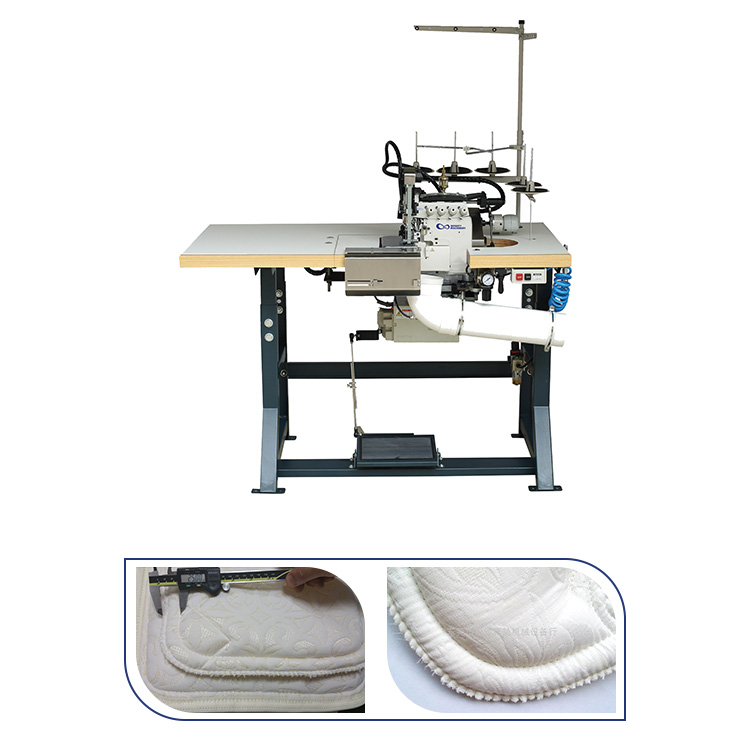
For factories that run multiple shifts and process a high volume of mattresses — or work with particularly heavy upholstery fabrics — the IF-SBJ70 Mattress Flanging Machine is the heavy-duty choice. It features a JUKI industrial sewing head with double-bolts straight needle design, capable of handling both thin and thick fabrics without adjustment.
The IF-SBJ70's JUKI sewing head is a significant advantage for factories that value reliability. JUKI is one of the most respected names in industrial sewing, known for heads that run for years with minimal maintenance. The double-bolts straight needle design provides exceptional needle penetration force, making it ideal for thick mattress border fabrics — including quilted borders, reinforced corners, and multi-layer upholstery materials.
Like the IF-SBP80, the IF-SBJ70 is powered by a Taiwan servo motor that maintains consistent stitch quality regardless of speed. The motor's electronic control system automatically adjusts torque to maintain needle penetration through thick seams and fabric overlaps, preventing skipped stitches that create weak points in the border.
The IF-SBJ70 and IF-SBP80 are complementary machines. Many factories run both — the IF-SBP80 for standard production (where its synchronous feeding and fabric expander deliver the best finish) and the IF-SBJ70 for heavier fabrics, custom orders, and backup capacity. Having both machines on the floor gives you flexibility: if one needs maintenance, the other keeps production running.
A factory in Nigeria that installed both machines told us: "We used to have one flanging machine and two operators per shift — one to run the machine and one to fix the mistakes. The border quality was inconsistent, and we were returning about 6% of mattresses for border rework. After installing the IF-SBP80 and IF-SBJ70, we run one operator per shift. Rework dropped to 0.5%. And our customers started asking why the mattresses looked so much better — which is exactly the reaction you want."
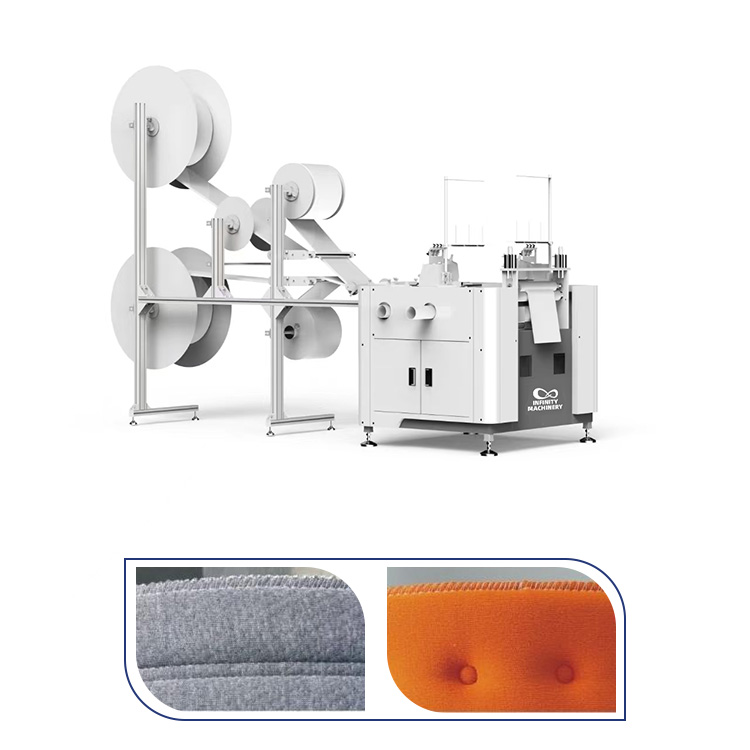
Once the border is flanged, the next step is assembling the mattress panels. The IF-SB-A2 Front and Back Double-heads Mattress Sewing Machine is the natural complement to a professional flanging line. Its dual-head design sews both the front and back panels simultaneously, doubling the panel sewing output of single-head machines — ensuring that your finishing line doesn't trade one bottleneck (flanging) for another (panel sewing).
The IF-SB-A2 also features a direct-driven servo motor, adjustable fabric expanding device, and automatic rolling mechanism with cloth cutting — all features that support consistent, high-quality panel production. When your flanging line is producing perfectly finished borders, the last thing you want is a bottleneck at the sewing station that limits your overall output.
Most factories that upgrade their flanging to the IF-SBP80 or IF-SBJ70 end up adding the IF-SB-A2 within 3–6 months, once they see the quality improvement and increased throughput from the flanging station. The complete finishing line — IF-SBP80/IF-SBJ70 → IF-SB-A2 — can more than double the output of a manual finishing operation while delivering consistently higher quality.
The numbers are straightforward. The IF-SBP80 or IF-SBJ70 costs between $5,500 and $8,500 depending on configuration and accessories. The additional cost to produce a premium flanged border — including the machine depreciation, consumables, and slightly higher labor time — is approximately $0.47 per mattress compared to a basic tape-edge finish.
The selling price premium for a professionally flanged mattress varies by market, but our data across 12 brands shows a consistent range of $80–$160 wholesale. At the conservative end of that range ($80 premium), the return on the $0.47 investment is 17,000%. At the realistic end ($160), it's 34,000%.
But even if you don't increase your selling price — even if you keep your prices the same and just reduce returns and rework — the math still works. Our data shows that factories upgrading from basic finishing to professional flanging reduce border-related returns by 85–92%. For a factory producing 5,000 mattresses per year with a 4% return rate, that's 200 returned mattresses saved. At an average return cost of $35 per mattress (shipping, inspection, rework, re-packing), that's $7,000 in annual savings — enough to pay for the machine in under a year.
| Your Numbers | Example Factory | Your Estimate |
|---|---|---|
| Mattresses produced per year | 5,000 | ___ |
| Current border return rate | 4% | ___% |
| Annual return savings (85% reduction) | $7,000 | $___ |
| Price premium (conservative) | $80/mattress | $___ |
| Additional annual revenue (5,000 × $80) | $400,000 | $___ |
| Equipment payback (from savings alone) | <12 months | ___ months |
Price premium data from 12 mattress brand tests across Malaysia, Nigeria, Egypt, and Mexico, 2024–2025. Return rate improvement from 18 factories that upgraded their flanging equipment.
The decision to upgrade your flanging line comes down to one question: do your customers care about the border? Our data says yes — they care enough to pay $80–$160 more for a mattress with a professionally finished border. And the cost to deliver that finish is $0.47 per mattress.
The IF-SBP80 and IF-SBJ70 aren't just flanging machines. They're the tools that let you capture that premium consistently, on every mattress, every shift, without depending on a skilled operator's mood or energy level. And in a market where the difference between a $300 mattress and a $450 mattress is often just the border, that consistency is worth more than any other quality improvement you can make.
Send us your current mattress volume, border return rate, and target selling price. We'll calculate your exact payback period for the IF-SBP80 or IF-SBJ70 — free and usually within 24 hours.