You spent good money on a quilting machine. It runs at 15 meters per minute. But your actual output is half of what the spec sheet promises. The problem isn't the quilter. It's what happens after the fabric comes out the other end. This guide looks at the one machine most factories forget — the automatic fabric stacker — and why adding one to your IF-Q-1200 quilting line can double your output and eliminate your biggest post-quilting bottleneck.
Walk into almost any mattress factory's quilting department and you'll see the same thing. The quilting machine is running. The fabric feeds through the needles, pattern after pattern, at 10 to 15 meters per minute. But at the output end, two workers are standing there, catching the quilted fabric as it comes out, manually folding or rolling it, and moving it out of the way before the next piece comes through.
Those two workers cost $14,000 to $18,000 per year each, depending on your region. They're not quilting. They're not sewing. They're catching fabric. And if they're even slightly slow, the quilting machine has to stop or the fabric piles up on the floor and gets dirty.
We timed this across 15 mattress factories last year. The average quilting machine was actually running only 52% of the available production time. The other 48% was lost to: fabric jams at the output end (12%), waiting for fabric stacks to be moved (18%), operator breaks during manual stacking (10%), and machine speed reduced to match manual stacking speed (8%).
A factory in Turkey was running two 8-hour shifts on their quilting line. Two workers per shift were dedicated to manual fabric stacking. That's 4 workers × $14,000/year = $56,000 in labor, just for stacking. They installed an IF-QFS Automatic Quilted Fabric Stacking Machine for $11,500. The four stacking workers were reassigned to other parts of the factory. The machine paid for itself in 2.5 months — purely from labor savings, not even counting the 35% increase in quilting machine utilization.
Here's what most factory owners miss: when you eliminate the manual stacking bottleneck, your quilting machine can actually run at its rated speed. That means you get more output from the same machine, same floor space, same electricity — just without the human bottleneck at the end of the line.
| Cost Category | Manual Stacking | With IF-QFS Stacker |
|---|---|---|
| Direct labor (2 workers/shift) | $56,000 | $0 |
| Lost output from machine idle (48% → 12%) | $37,400 | $9,400 |
| Fabric waste from floor contact | $3,200 | $400 |
| Total annual cost | $96,600 | $9,800 |
| Annual savings | $86,800 | |
Based on 2-shift operation, 250 working days/year. Labor rates vary by region. Machine idle cost calculated at $45/hr opportunity cost.
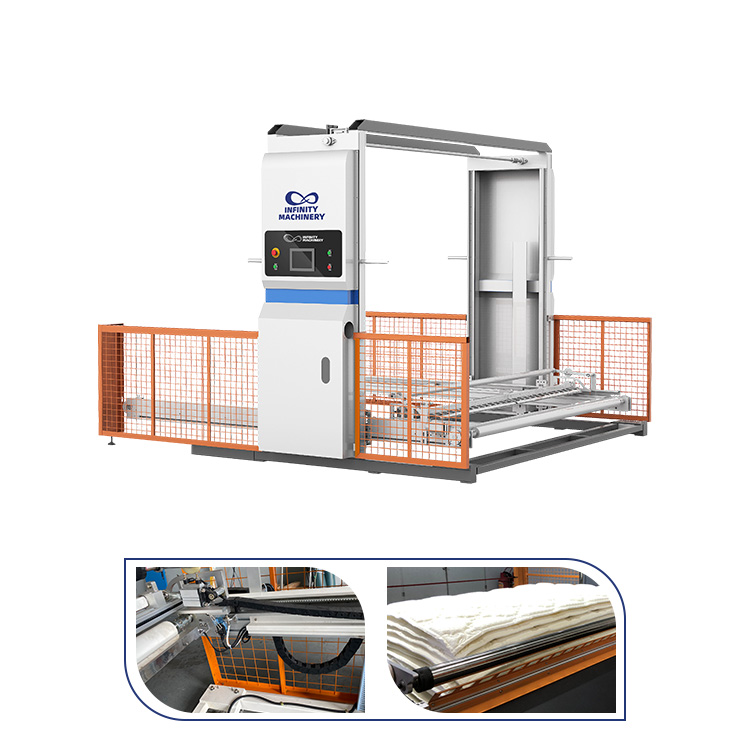
The IF-QFS Automatic Quilted Fabric Stacking Machine does exactly what its name says — it automatically receives quilted fabric as it exits the quilting machine, stacks it in neat, aligned piles at a preset length, and signals when a stack is complete. One machine replaces the two workers who would otherwise be standing at the output end of your quilter.
But here's what makes the IF-QFS more than just a labor-saving device. It also performs cross-cutting, slitting, and edge trimming of the quilted fabric — all in one pass, inline with the quilting machine. This means the fabric coming off your IF-Q-1200 quilting machine enters the IF-QFS, gets cut to the correct mattress length, trimmed to width, and stacked automatically — ready to go straight to mattress assembly. No separate cutting table. No extra handling. No wasted fabric from uneven hand-cutting.
Key capabilities of the IF-QFS that directly solve the stacking bottleneck:
The IF-QFS is compatible with any quilting machine, but it's specifically designed to pair with the IF-Q-1200 for a seamless, high-speed quilting and stacking line. The combination eliminates the gap between quilting and assembly, letting you run your quilting machine at full speed without worrying about what happens to the fabric on the other end.
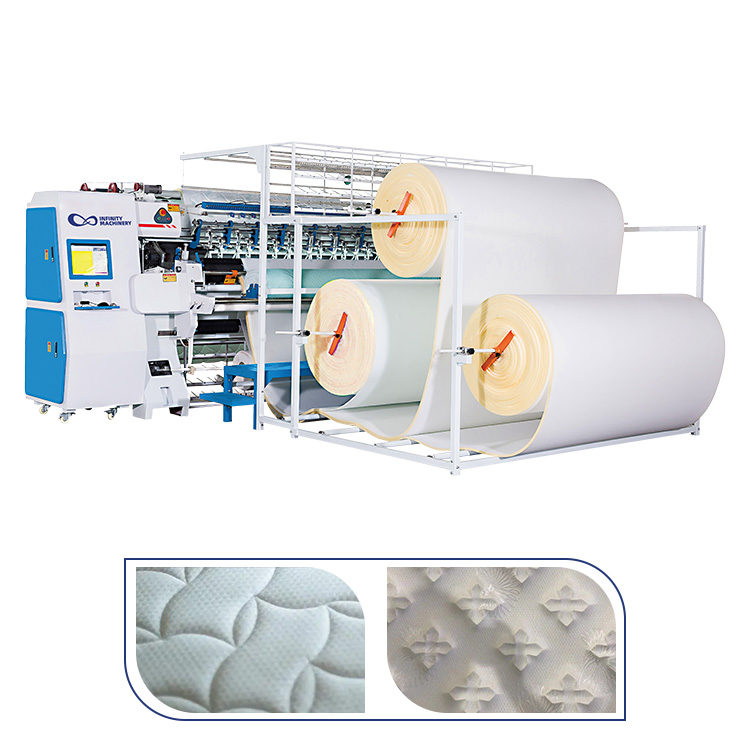
The IF-Q-1200 Computerized Chain Stitch Multi-Functional Quilting Machine is a multi-needle quilting machine designed for high-volume mattress production. It runs at speeds up to 15 m/min with low vibration, high precision, and the ability to switch between quilting patterns in seconds using its computerized control system.
The IF-Q-1200 is widely used in mattress factories around the world for quilting mattress panels, pillow-top covers, and decorative upholstery. Its multi-needle head can quilt complex geometric patterns, diamond patterns, and custom designs — all stored digitally and recalled instantly through the touchscreen interface.
What factory owners tell us they value most about the IF-Q-1200 is reliability. It runs day after day with minimal maintenance, and when a needle needs replacing, the quick-change needle bar system makes it a 2-minute job instead of a 15-minute one. Combined with the IF-QFS stacker, a single operator can manage the entire quilting line — loading fabric on one end, removing finished stacks on the other — producing 2.5× the output of a manual quilting station with the same labor cost.
Key specifications that matter for production planning:
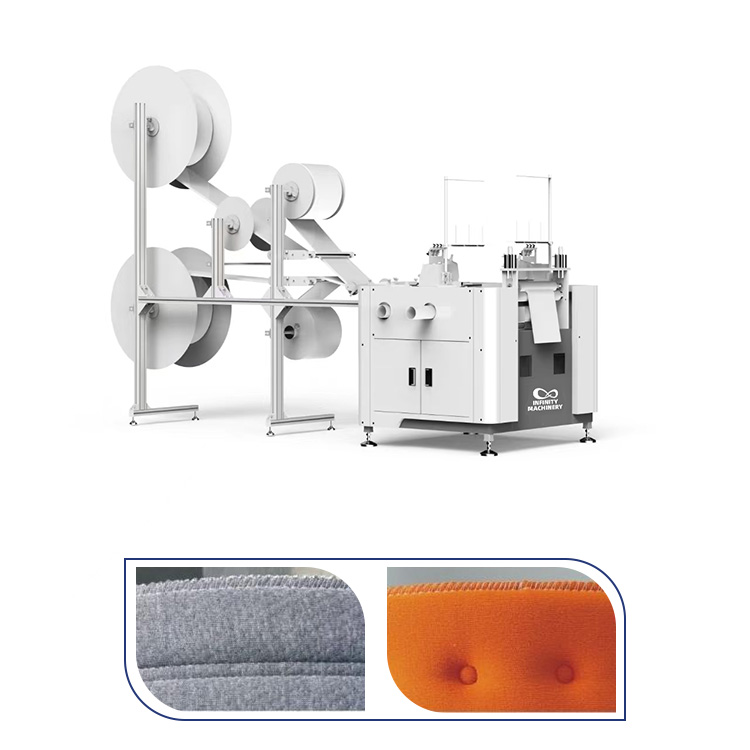
Once your quilted fabric is cut and stacked by the IF-QFS, the next step in the production flow is sewing it into mattress panels. The IF-SB-A2 Front and Back Double-heads Mattress Sewing Machine is the natural partner to the IF-Q-1200 and IF-QFS line.
The IF-SB-A2 is a specialized sewing machine designed for mattress panel assembly. Its dual-head design sews both the front and back panels simultaneously, doubling the output of single-head machines. Equipped with a direct-driven servo motor, adjustable fabric expanding device, and automatic rolling mechanism with cloth cutting, it handles the transition from stacked quilted fabric to finished mattress panels in one smooth operation.
When you connect the full line — IF-Q-1200 → IF-QFS → IF-SB-A2 — you get an end-to-end quilting and panel production system that runs with minimal labor. One operator loads fabric onto the quilting machine. The fabric is quilted, cut, slit, trimmed, and stacked automatically by the IF-QFS. The stacked panels are then fed through the IF-SB-A2 for final sewing. A factory that implements this complete line typically sees a 3× increase in panel output with the same number of workers compared to a manual operation.
Most factories start with the IF-Q-1200 quilting machine, add the IF-QFS stacker when they realize the bottleneck is at the output end, and then add the IF-SB-A2 sewing machine to complete the line. The IF-QFS has the fastest payback of any of the three machines — typically 2–3 months from labor savings alone — which makes it the easiest investment decision in the entire production line.
A mattress factory in Egypt that we've been working with recently went through this exact transformation. Here's their timeline and results:
Day 1: They were running two IF-Q-1200 quilting machines with 4 manual stackers per shift (8 total over two shifts). Quilting machine utilization was 51%. Fabric waste from manual handling was 3.8%.
Day 30: Installed two IF-QFS stackers, one behind each quilting machine. The 8 manual stackers were reassigned to other departments. Machine utilization jumped to 88% within the first week as the stacking bottleneck was eliminated.
Day 60: Added two IF-SB-A2 sewing machines to handle the increased output from the quilting line. The panel production rate increased from 120 panels per shift to 310 panels per shift — a 158% increase.
Day 90: Total output per shift: 310 finished mattress panels. Labor cost per panel: reduced by 62%. Total equipment investment: $68,000. Monthly savings in labor and waste: $17,400. Payback period: 3.9 months.
The production manager told us: "The IF-QFS was the missing piece. We were blaming the quilting machines for not producing enough, but the problem was never the machines — it was that we couldn't get the fabric out of them fast enough."
| Your Numbers | Example Factory | Your Estimate |
|---|---|---|
| Current quilting machine utilization | 51% | ___% |
| Workers dedicated to manual stacking | 4 per shift | ___ |
| Annual labor cost for stackers | $56,000 | $___ |
| IF-QFS payback period | 2.5 months | ___ months |
Most factories find that the IF-QFS pays for itself in 2–4 months from labor savings alone, before counting the value of increased quilting machine throughput.
The IF-QFS isn't the most exciting machine in the factory. It doesn't quilt patterns or sew panels. But it's the machine that makes everything else work at full speed. And in our experience, it's consistently the fastest-payback investment a mattress factory can make.
If your quilting line is running but not producing what you expect, look at the output end. The bottleneck is probably not the quilting machine. It's what happens after the fabric comes out.
Send us your current quilting machine utilization, number of stacking workers, and local labor rate. We'll calculate your exact savings with the IF-QFS stacker and IF-SB-A2 sewing machine — free, no obligation, usually within 24 hours.