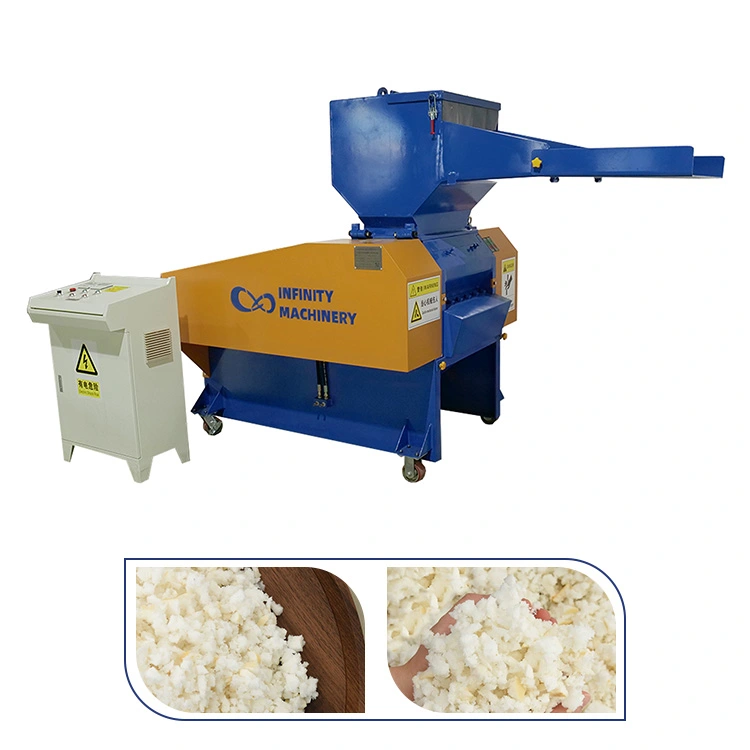
You're running a foam factory. Every day you generate scrap — edge trimmings, offcuts, blocks that didn't cure right. What do you do with it? If you're like 90% of factories, you either throw it away or sell it to a recycler for pennies. But here's what you're missing: that scrap is raw material for a completely different product line. One that sells for more per kilo than your primary foam. Rebond foam. A factory in Vietnam — let's call them Sai Gon Foam — was throwing away 4 tons of scrap every month. They bought an IF-FFS3 crusher and an IF-FZS1 rebond machine. Four months later, the equipment had paid for itself. Here's exactly how they did it.
Every foam factory has waste. It's built into the process. You trim blocks to size — scrap. You cut profiles — scrap. A batch doesn't come out right — scrap. On a typical production line running 50 tons of foam per month, 5-8% ends up as waste. That's 2.5 to 4 tons of material. Gone.
Most factories sell this scrap to third-party recyclers for $0.20-$0.50 per kg — if they can find a buyer. Others pay to have it hauled away. Either way, you're losing money on material you already paid for.
But here's what the smart factories have figured out: foam scrap isn't waste. It's raw material for rebond foam. Rebond foam (also called reconstituted foam) is made by shredding scrap, mixing it with adhesive, and compressing it into blocks. It sells for $3-$6 per kg depending on density. The margins are often better than your primary foam products.
Sai Gon Foam is a mid-size foam producer in Vietnam. They run two shift lines producing polyurethane foam for mattresses and furniture. Every month they generated about 4 tons of scrap foam. They were paying a local recycler $600/month to take it away. Total loss: the raw material cost of that scrap (about $4,800/month) plus disposal fees.
The owner had heard about rebond foam but assumed the equipment was too expensive and complicated. When a competitor started selling rebond foam to carpet underlay buyers, he finally ran the numbers. He realized the payback was faster than almost any other equipment investment he could make.
They bought two machines that work together as a mini production line:
Step 1: Crush the Scrap — IF-FFS3 Crushing Foam Machine
The IF-FFS3 Crushing Foam Machine is the first step. It takes scrap foam — trimmings, offcuts, rejected blocks, even cloth waste — and shreds them into uniform granules. The machine uses 4 stationary cutters and 3 rotary cutters working together. The stationary blades break down large pieces. The rotary blades pulverize them to a consistent particle size. This uniformity is critical because uneven particles create weak spots in the final rebond block.
The IF-FFS3 handles everything: soft polyurethane foam, memory foam scraps, HR foam, even fabric waste from quilting operations. The output capacity is 500-1200 kg per hour, depending on material density. Sai Gon Foam runs theirs for 4 hours per day and processes all their scrap plus some purchased from neighboring factories.
Step 2: Bond + Press — IF-FZS1 Re-Bonding Foam Machine
Once the foam is crushed into uniform granules, the IF-FZS1 Re-Bonding Foam Machine takes over. The granules are mixed with a specialized adhesive in a large stirring drum. Then the mixture is loaded into a mold and compressed under hydraulic pressure while steam is injected to cure the bond.
The steam activation is the key. It ensures the adhesive penetrates every particle and creates a consistent bond throughout the block. Without steam, you get weak spots and delamination. The IF-FZS1 uses a 200L boiler system to generate the steam, and the hydraulic press applies even pressure across the full mold size of L2100×W1600×H1850mm.
Sai Gon Foam runs the IF-FZS1 for 6 hours per day and produces about 3.5 tons of rebond blocks per month from their 4 tons of scrap (the volume loss is from moisture and adhesive absorption). Each block sells for $4/kg to carpet underlay manufacturers and furniture cushion producers.
Here's the actual financial breakdown from Sai Gon Foam's first 4 months of operation:
| Item | Before Rebond | After Rebond |
|---|---|---|
| Monthly scrap generated | 4 tons | 0.5 tons (non-recyclable only) |
| Scrap disposal cost | -$600/month | -$0 |
| Raw material value of scrap | -$4,800 (wasted material) | $0 (reused) |
| Rebond output value | $0 | ~$14,000/month (3.5 tons × $4/kg) |
| Monthly operating cost | $0 | -$3,800 (adhesive + steam + labor) |
| Net monthly impact | -$5,400 | +$10,200 ($15,600 swing) |
Equipment cost: IF-FFS3 ($8,500) + IF-FZS1 ($11,200) + installation & training ($1,500) = $21,200 total
Payback period: $21,200 ÷ $10,200 = 2.1 months
Sai Gon Foam's actual payback was 4 months because they spent the first 2 months dialing in the adhesive formula and finding buyers. Once they had both figured out, the machine was generating $10,200/month in net profit. The owner told us: "I was throwing away $60,000 a year. Now that same material pays me $120,000 a year. Same scrap, different machine."
If you're wondering who actually buys rebond foam, the answer is more customers than you think:
Sai Gon Foam now sells rebond to customers in Vietnam, Cambodia, and Thailand. They could sell more if they increased production — they're currently operating at 70% capacity with the IF-FFS3 and IF-FZS1.
Once your rebond operation is running and profitable, you'll face a new problem: the rebond blocks need to be cut into sheets for customers. And they're dense. Your existing foam cutting machines might struggle with the higher density of rebond foam.
The IF-FYP6/7/10 Carrousel Splitting Foam Cutting Machine is the perfect companion for a rebond operation. It's a fully automatic digital-controlled carrousel that holds multiple foam blocks and slices them to precise thickness. The operator sets the thickness on the control box, the machine runs. Inverter speed control gives smooth, vibration-free cutting — critical for dense rebond blocks. Cutting accuracy stays at ±0.1mm.
Sai Gon Foam added an IF-FYP7 (7-meter diameter, 5 blocks per cycle) after their first year. It lets them cut rebond blocks into sheets for carpet underlay customers in a single pass. They also use it to cut their primary foam blocks, so the machine serves double duty. The IF-FYP6 holds 4 blocks, the IF-FYP7 holds 5, and the IF-FYP10 holds 8 — choose based on your volume.

Diameter: 6/7/10.5m | Block capacity: 4/5/8 pcs | Precision: ±0.1mm | Speed: Up to 3.5 r/min
High-volume carrousel splitting machine that handles both primary foam and dense rebond blocks. Fully automatic digital control with inverter speed control and optional vacuum table. Cuts foam thickness from 2-150mm. Perfect companion to the IF-FFS3 and IF-FZS1 — once you've made the rebond, this machine cuts it to customer specs. Sai Gon Foam uses theirs for both primary and rebond foam cutting.
Here's a quick self-assessment. If these apply to you, the numbers almost certainly work:
Sai Gon Foam had all five. After the IF-FFS3 and IF-FZS1, they went from losing $5,400/month on scrap to making $10,200/month on rebond. The production manager's final words: "I wish we'd done this three years ago. We were sitting on a goldmine and didn't know it. The IF-FFS3 and IF-FZS1 are simpler to run than our main foaming line. Two of our existing workers trained on them in one shift."
Here's what Sai Gon Foam learned — and what every foam factory should know:
If you're generating foam scrap and not turning it into rebond, you're leaving money on the table. The IF-FFS3 and IF-FZS1 cost about $21,000 combined. They'll pay for themselves before you've figured out your third customer.
Send us your monthly scrap volume and current disposal cost. We'll tell you exactly what equipment you need, how much rebond you can produce, and what your payback period will be. Free, no obligation.