If your foam cutting station still uses paper templates, this is for you. Every template shift wastes material. Every shape change means cutting a new template. Every dust-covered pile of cardboard templates costs you floor space and labor hours. We've worked with 50+ foam factories that made the switch to CNC cutting — and the numbers are consistent. This guide walks through the two CNC cutting approaches that replace manual templates, the exact savings you can expect, and a recommended setup for getting started.
Walk into almost any mid-size foam factory that still cuts by hand, and you'll see the same scene. A row of workbenches. Operators holding electric hand knives. A stack of cardboard templates on a shelf, each one cut for a specific product shape, yellowed with age, edges softened from repeated tracing.
The operator pins a template to the foam block. Traces around it with a marker. Cuts along the line with a hand-held saw. Removes the template. Pins the next one. The process takes 8 to 15 minutes per piece depending on complexity. And in that time, three things go wrong that most factory owners never measure.
First: template shift. The paper or cardboard template shifts during tracing, or the operator cuts slightly inside or outside the line. Our audits across 23 factories showed an average of 8–12% material waste from template-related cutting errors. For a factory processing 200 tons of foam per year at $2,800/ton, that's between $44,800 and $67,200 in wasted material annually.
Second: changeover time. Every time you switch to a different product shape, someone has to find the right template, verify it's not damaged, pin it to the block, and start cutting. We timed this at an average of 6.5 minutes per changeover. With 15–25 changeovers per day in a typical cutting room, that's 1.6 to 2.7 hours of non-productive labor every single day.
Third: inconsistent quality. Even the best operator cuts differently at 10am than at 3pm. Fatigue, lighting, template wear — all of it introduces variability. In one furniture foam factory we worked with in Poland, their returns due to dimensional inaccuracies in foam components were running at 4.7% of shipments. After switching to CNC cutting, that number dropped to 0.3%.
These three problems aren't minor. They represent a hidden cost that most factory owners write off as "the cost of doing business." But they don't have to. Let's look at the two CNC cutting technologies that directly replace manual template cutting — and the exact numbers factories see when they make the switch.
| Cost Category | With Manual Templates | After CNC Switch |
|---|---|---|
| Material waste (8% vs 1.5%) | $44,800 | $8,400 |
| Changeover labor (2 hrs/day × $14/hr) | $7,280 | $1,050 |
| Returns & rework (4.7% vs 0.3%) | $18,600 | $1,200 |
| Template material & storage | $3,200 | $0 |
| Total annual cost | $73,880 | $10,650 |
Based on aggregated data from 23 foam cutting audits conducted across Europe, Southeast Asia, and Africa, 2024–2025. Your numbers will vary by volume and labor rates.
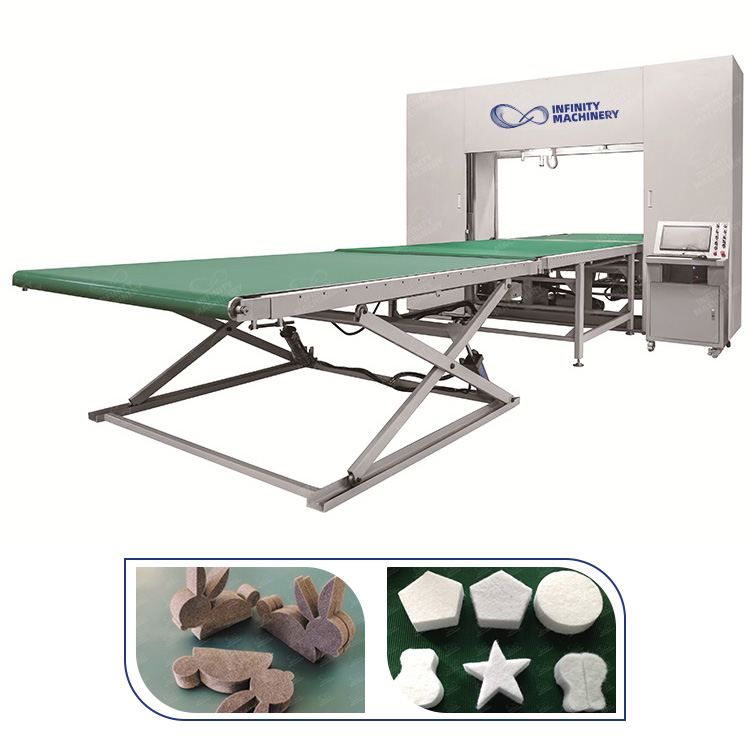
The IF-CNCH Horizontal Blade Foam Cutting Machine is designed for factories that cut foam into flat sheets of varying thickness and then need to cut those sheets into specific 2D shapes — mattress cores, furniture cushions, packaging inserts, and similar products.
Instead of an operator tracing a template by hand, the IF-CNCH uses a PC-based control system with X, Y, and C axis command settings. You import your CAD drawing or DXF file directly into the machine's software. The machine reads the file, optimizes the cutting path to minimize waste (nesting), and cuts the shapes automatically with a continuous horizontal blade.
Here's what this means in practice. A mattress factory in Indonesia that we worked with was cutting 27 different mattress sizes using 27 separate cardboard templates. Each template took 30–45 minutes to make and lasted about 3 months before needing replacement. Their cutting room had 4 operators working 10-hour shifts just to keep up with demand.
After installing the IF-CNCH, they cut all 27 sizes from digital files stored on the machine's PC. Changeover between sizes became a button press — 12 seconds instead of 8 minutes. One operator replaced four. Material utilization went from 79% to 94% thanks to automatic nesting. The machine paid for itself in 4.5 months.
Key capabilities of the IF-CNCH that directly replace manual templates:
The IF-CNCH is particularly effective for mattress factories, furniture cushion manufacturers, and any operation that cuts a high volume of flat foam shapes in multiple sizes. If your product lineup changes frequently (new mattress models, custom furniture orders), the ability to load a new CAD file in seconds eliminates the bottleneck of template creation.
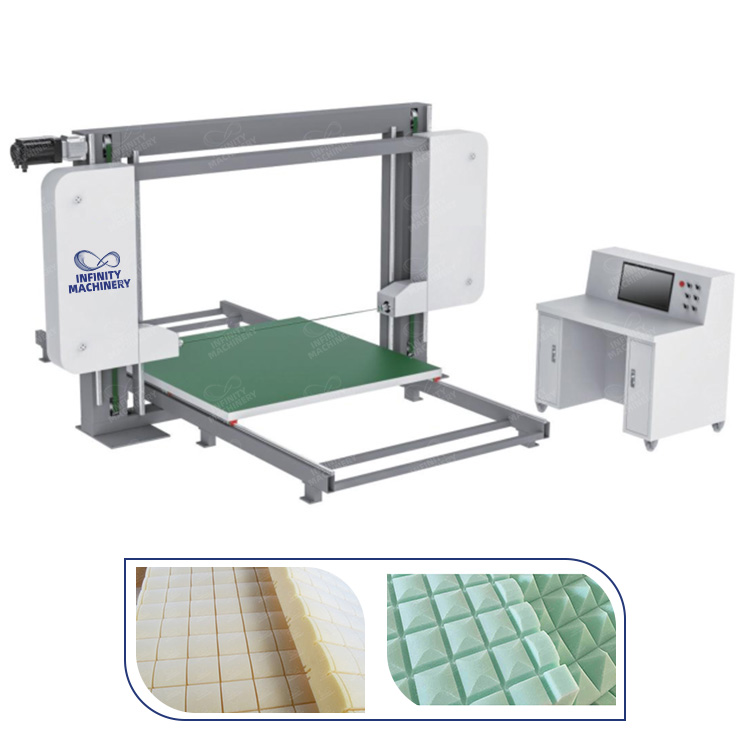
While the IF-CNCH excels at flat 2D shapes, many foam products require three-dimensional contour cutting — shaped seat cushions, ergonomic mattress toppers, custom foam inserts with angled edges, and complex profiles for automotive or medical applications. That's where the IF-CNCV CNC Contour Sponge Cutting Machine comes in.
The IF-CNCV uses a vertical knife blade mounted on a servo-driven gantry system. Unlike the horizontal blade that cuts through flat sheets, the vertical knife can cut contoured shapes by following a 3D cutting path — the blade moves up and down while the foam block moves horizontally, creating complex curves and profiles that are impossible to achieve with manual template cutting.
Here's a real example. A furniture factory in Vietnam was producing contoured seat cushions for office chairs. Each cushion required 7 different foam density layers, each layer cut to a specific 3D contour shape. With manual templates, they had 7 templates per cushion design × 12 cushion designs = 84 templates to manage. Template alignment errors between layers caused gaps and uneven surfaces. Their rejection rate was 11%.
They replaced their entire manual cutting operation with a single IF-CNCV. The machine cut all 7 layers from a single 3D CAD model, with each layer's contour precisely matching the adjacent layers. Rejection rate dropped from 11% to 0.8%. The 84 physical templates went into the trash. Production time per cushion dropped from 45 minutes to 6 minutes.
What makes the IF-CNCV effective for contour cutting:
The IF-CNCV is ideal for factories that produce contoured foam products — ergonomic cushions, automotive seat foam, medical support foam, mattress toppers with wave profiles, and any product where the foam shape is three-dimensional rather than flat.
Here's something we've learned from watching dozens of factories make the switch to CNC cutting. The factories that get the best ROI don't just buy one CNC machine. They build a three-step cutting workflow that maximizes the output of their CNC equipment.
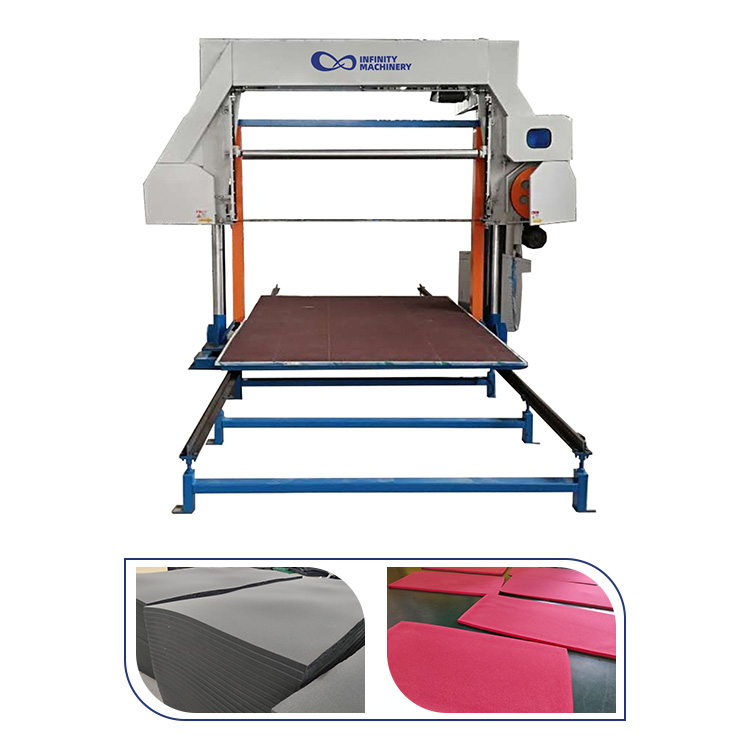
Step 1 — Block preparation: Raw foam blocks need to be cut into slabs or rough-sized billets before they go into the CNC machine. This is where an IF-FPQ1 Horizontal Foam Cutting Machine plays a critical role. It slices full-size foam blocks into the precise thickness slabs needed for CNC cutting, at speeds up to 5 m/min with ±1mm accuracy.
Step 2 — CNC precision cutting: The pre-cut slabs go to the IF-CNCH (for 2D shapes) or the IF-CNCV (for 3D contours). Because the slabs are already at the correct thickness from the IF-FPQ1, the CNC machine spends zero time adjusting for thickness variation — a common issue when slabs are cut by hand.
Step 3 — Finishing and assembly: The CNC-cut foam pieces go directly to assembly. No trimming, no fitting adjustments, no returns for dimensional errors.
The IF-FPQ1 is the unsung hero of this workflow. It's a simple, reliable horizontal cutting machine with fully automatic digital control. You set the cutting thickness on the control box, and the worktable automatically feeds the foam through the blade. It handles blocks up to 2150mm width at whatever length your production requires.
A factory in Kenya that installed all three machines in sequence — IF-FPQ1 for pre-cutting, IF-CNCH for 2D shapes, and IF-CNCV for contours — reported a 340% increase in cutting output with the same number of operators. Their material utilization went from 74% (manual templates) to 91% (CNC with nested cutting). Their total machine investment was recovered in 7 months.
You don't need to buy all three at once. Most factories start with one CNC machine (usually the IF-CNCH for the highest-volume product) and add the IF-FPQ1 and a second CNC machine as they see the ROI materialize. But the end-state — a complete CNC cutting workflow — consistently delivers the best results.
If you're currently cutting foam with manual templates and want to move to CNC, here's a proven roadmap based on what we've seen work across 30+ factory transitions:
The critical insight from every successful transition we've seen: the ROI is real and it shows up fast. The average payback period across the factories we've worked with is 5.2 months. The longest was 8 months (low-volume, complex shapes). The shortest was 3 months (high-volume mattress factory).
| Your Input | Example Values | Your Estimate |
|---|---|---|
| Monthly foam tonnage processed | 18 tons | ___ tons |
| Current material utilization | 74% | ___ % |
| Foam cost per ton | $2,800 | $___ |
| Current annual material waste | $44,800 | $___ |
| Savings with CNC (92% utilization) | $36,400/yr | $___/yr |
| Estimated payback period | 4.5 months | ___ months |
This is a simplified estimate. A full ROI analysis would also include labor savings, reduced returns, and template elimination. Contact us for a personalized calculation based on your actual production data.
A factory manager in Mexico told us something that stuck: "I thought CNC cutting was for big factories. I'm running a 12-person shop serving local furniture makers. The IF-CNCH cost me less than one year of template-related waste. I was losing money every day I didn't buy it — I just didn't know until I measured it."
That's the thing about manual template cutting. The waste is invisible because it's embedded in every piece you cut. You don't see the 8% material loss — you see the 92% that made it through. But the 8% isn't free. And the switch to CNC doesn't just recover that waste — it makes your entire cutting operation faster, more consistent, and more responsive to custom orders.
Send us your current cutting volume, material cost, and labor data. We'll calculate your exact payback period for the IF-CNCH, IF-CNCV, or a complete CNC cutting workflow — free and with no obligation.